
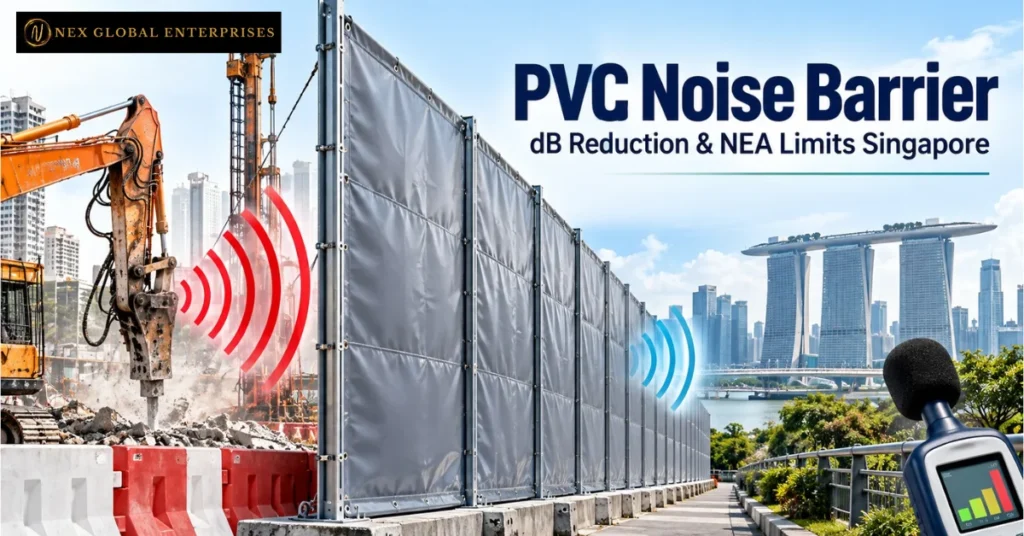
How Much Noise Does a PVC Noise Barrier Actually Block on a Singapore Construction Site? NEA Limits Explained
Singapore builds in tight spaces. A new condo, an MRT station or a road widening job is often only a few metres from HDB blocks, schools and hospitals. That means the noise from piling, hacking and heavy machinery reaches people almost straight away, and the National Environment Agency (NEA) takes it seriously.
For contractors, the question is practical: if you put up a PVC sound barrier along the hoarding, how much quieter does it really get, and is that enough to stay within the NEA limits? This guide answers both, with the numbers, the rules and the installation details that decide whether a barrier works or just looks good.
The Short Answer: What a PVC Barrier Can Realistically Do
A well-installed laminated PVC noise barrier usually cuts somewhere in the range of 10 to 20 dB(A) for people standing behind it, compared with an open hoarding.
A drop of 10 dB is heard by most people as roughly half as loud, so a good barrier can turn a site that residents complain about into one they barely notice.
The catch is the word "well-installed". The same sheet can give 15 dB on one site and only 3 or 4 dB on another, because of gaps, height and distance.
Why the Range Is So Wide
Sound behaves a bit like water. It finds every gap. A barrier that is 95 percent sealed can lose a large part of its benefit through the last 5 percent.
Barrier height, how close it sits to the noise source and whether nearby blocks reflect sound back over the top all change the final result.
NEA Construction Noise Limits in Singapore
Noise at construction sites is controlled under the Environmental Protection and Management (Control of Noise at Construction Sites) Regulations.
The limits are measured at the nearest affected building and depend on two things: what kind of building is nearby and what time of day it is.
Limits for Sites Near Residential Buildings
These are the commonly cited maximum permissible levels for sites within 150 metres of residential buildings on Mondays to Saturdays.
| Time Period | Leq Over the Period | Leq Over 5 Minutes |
|---|---|---|
| 7am to 7pm | 75 dB(A) over 12 hours | 90 dB(A) |
| 7pm to 10pm | 65 dB(A) over 1 hour | 70 dB(A) |
| 10pm to 7am | 55 dB(A) over 1 hour | 65 dB(A) |
Limits Near Hospitals, Schools and Homes for the Aged
Noise-sensitive premises get stricter limits, especially at night.
| Time Period | Leq Over 12 Hours | Leq Over 5 Minutes |
|---|---|---|
| 7am to 7pm | 60 dB(A) | 75 dB(A) |
| 7pm to 7am | 50 dB(A) | 55 dB(A) |
The No-Work Rule on Sundays and Public Holidays
Since September 2011, construction work has been banned on Sundays and public holidays at sites within 150 metres of homes and noise-sensitive premises.
The quiet window runs from 10pm on Saturday, or the eve of a public holiday, until 7am on the following Monday or the day after the holiday.
What Counts as Quieter Work?
Since January 2017, sites at the architectural or completion stage have been able to carry out selected quieter works on those days, but only with approval.
Painting, cleaning and interior finishing are the typical examples. Piling, hacking and concrete breaking are not.
How a PVC Sound Barrier Actually Reduces Noise
Blocking Versus Absorbing
A barrier works mainly by blocking. It stops sound from travelling in a straight line from the machine to the listener, so the sound has to bend over the top edge.
That bending, called diffraction, is where most of the reduction comes from.
Why Surface Mass Matters
Heavier sheets block more sound. A laminated sheet made from two PVC layers bonded to a high-tenacity polyester base is dense, tough and flexible at the same time.
That is why it outperforms a plain tarpaulin, which is light and lets a lot of low-frequency noise pass straight through.
Line of Sight and Barrier Height
If a resident on the 10th floor can see the excavator over the top of your hoarding, the barrier is doing very little for that resident.
As a simple rule, the barrier should break the line of sight between the noise source and the receiver.
What to Expect for Common Site Activities
| Activity | Noise Character | What a Barrier Can Do |
|---|---|---|
| Bored piling and drilling | Continuous, heavy low-frequency | Good reduction if the barrier is close and tall |
| Impact piling | Very loud, impulsive peaks | Helps, but often needs an enclosure or a quieter method too |
| Hacking and concrete breaking | Sharp, high-frequency | Very effective, because high frequencies block easily |
| Generators and concrete pumps | Steady engine hum | Effective when the unit is wrapped on three or four sides |
| Road and highway works | Moving, spread out | Mobile barrier panels that move with the work front |
Installation Mistakes That Kill Performance
Gaps at the Base and Joints
The most common problem is a gap under the sheet or between two panels. Overlap the joints, seal them with Velcro or eyelet ties, and make sure the bottom edge touches the ground or a kerb.
Barrier Too Far From the Source
A barrier works best close to the noise source or close to the receiver, and worst in the middle. Where you can, put a secondary barrier right around the loudest machine rather than relying only on the site boundary.
Loose Sheets Flapping in the Wind
A loose sheet in a Singapore storm is noisy, it wears through at the eyelets and it can become a safety hazard. Tie it at close spacing to the hoarding frame and check the ties after heavy weather.
Ignoring Reflections From Nearby Blocks
Flat concrete facades reflect sound back over the barrier. On narrow urban sites, an absorbent face on the site side helps, and so does tilting or extending the top edge.
A Simple Worked Example
Say your monitoring shows a 12-hour average of 82 dB(A) at the nearest HDB block during the day. The limit is 75 dB(A), so you are 7 dB over.
- A properly sealed PVC barrier that breaks line of sight and cuts 10 dB would bring you to about 72 dB(A), which is within the limit.
- If the same sheet has gaps and only delivers 4 dB, you are at 78 dB(A) and still over.
- Moving the generator 10 metres further from the boundary would add a few more decibels of reduction.
The lesson: the material matters, but installation decides whether you pass.
Protecting Your Workers, Not Just Your Neighbours
Barriers protect the public. Your workers inside the hoarding are still exposed to the full noise.
Ear plugs, ear muffs and regular hearing checks are part of a basic site kit, and you can source them together with your other industrial supplies Singapore orders so nothing gets missed.
What to Ask Before You Buy PVC Barrier Sheets
- What is the sheet made of?
- Is it fire resistant?
- How is it fixed?
- Can it handle UV and rain?
- Can the supplier cut to size?
- Is it reusable?
Getting the Setup Right
A PVC sound barrier is one of the most cost-effective noise controls a Singapore contractor can use.
Expect around 10 to 20 dB(A) of reduction from a good installation, check your numbers against the NEA limits for the nearest building, and pay as much attention to gaps, height and ties as to the sheet itself.
Frequently Asked Questions
How many decibels does a PVC noise barrier reduce?
A properly sealed laminated PVC barrier typically reduces noise by around 10 to 20 dB(A) for people behind it. Gaps, low height and long distances from the noise source can cut that benefit sharply.
What is the NEA noise limit for construction near homes in the daytime?
For sites within 150 metres of residential buildings, the commonly cited daytime limit from 7am to 7pm is 75 dB(A) averaged over 12 hours and 90 dB(A) averaged over 5 minutes.
Can construction work happen on Sundays in Singapore?
Not at sites within 150 metres of homes or noise-sensitive premises during the restricted period.
Is a normal tarpaulin enough to block construction noise?
Usually not. A standard PE tarpaulin is light and lets a lot of noise pass through. A laminated PVC barrier sheet is much denser.
Do my workers still need ear protection if I install a barrier?
Yes. The barrier reduces noise outside the site, but workers near the machines are still exposed to high levels and need proper hearing protection.
Can PVC barrier sheets be reused on the next project?
Yes. Good quality laminated sheets are tough and weather resistant, so they can be taken down, cleaned and reinstalled on the next site.